
Told It's Just Degeneration and Nothing Can Be Done? 5 Common Misconceptions

"Doctor, they told me it's degeneration.
They said it's just what happens with age..."
So many people come to us
saying exactly this.
They've already been diagnosed with a degenerative condition elsewhere
and arrive half-resigned.
And with everyone around them saying "that's just normal at your age,"
they gradually give up hope.
But when we actually examine them, there are quite a few cases
where people have given up unnecessarily simply because of the word "degenerative."
Today, let me sum up five common misconceptions
about degenerative conditions.
1. "If it's degenerative,
doesn't it just keep getting worse?"
The degenerative change itself is hard to reverse.
Once cartilage has worn down, it doesn't grow back.
But what many people misunderstand
is that the degree of degeneration and the level of pain
do not necessarily go hand in hand.
Even among those given the same degenerative diagnosis,
some have no real trouble in daily life,
while others struggle even to walk.
What makes this difference is not the joint itself, but
the condition of the surrounding soft tissues —
the muscles, ligaments, and bursae around the joint.
This part can be improved considerably
with proper care and treatment.
In other words, just because degeneration progresses
doesn't mean the pain and discomfort will inevitably worsen.
2. "Can a Korean medicine clinic
actually treat degeneration?"
Regenerating worn cartilage
is difficult with any treatment.
To be honest, that is true for us as well.
But that is not what our treatment is about.
Our goal is to improve the inflammation and functional decline
in the surrounding tissues caused by degenerative change,
and thereby reduce the pain and discomfort you actually feel in daily life.
When we check with ultrasound,
in most cases there is swelling around the degenerated joint,
or the ligaments have weakened,
or the muscles have become stiff.
We calm the inflammation with pharmacopuncture,
release muscle tension with acupuncture and electroacupuncture,
and treat in a direction that restores function step by step.
We cannot reverse the cartilage,
but pain and function can change.

3. "I'm getting on in years,
so wouldn't treatment be pointless?"
Being in your 50s or 60s
doesn't mean you won't respond to treatment.
Of course you won't recover at the same pace as someone in their 20s,
but you can fully expect changes such as
less pain and easier movement.
The patients who come to our clinic
are mostly in their 50s,
and many of them return to daily life through treatment.
What matters more, in fact, is timing rather than age.
If you endure the pain for a long time,
you move less in order to protect the sore area,
and as that continues,
the surrounding muscles also weaken, creating a vicious cycle.
Checking it early, as soon as something feels off,
ultimately
shortens the treatment period and makes recovery smoother.

4. "I can just take painkillers,
so do I really need treatment?"
There's nothing wrong with painkillers.
They clearly have a role in easing pain when you're in a pinch.
But there is one thing you should be aware of.
Painkillers reduce the pain signal —
they do not resolve the inflammation or tissue damage
that is the cause of the pain itself.
If you're fine while taking the medication but hurt again once you stop,
it means the cause of the pain is still there.
We use ultrasound
to confirm where the actual problem lies,
and provide treatment that directly approaches that source.
Momentarily suppressing the symptom
and approaching the cause are two different things.
There is a limit to getting by on painkillers,
so if the pain keeps recurring,
we recommend having the cause checked once.
5. "How many treatments until it's completely cured?"
This is the question I answer most carefully.
With degenerative conditions,
the term "complete cure" is not appropriate.
Because worn cartilage does not come back.
That said, reducing pain, restoring function,
and preventing recurrence are all fully possible.
We carry out treatmentshort-term pain relief → reduced swelling
→ functional recovery → recurrence prevention,
proceeding step by step like this.
It varies by condition, but
we usually treat intensively in the early stage
and then gradually widen the intervals.
At the first consultation, we put together a treatment plan
and explain the overall flow and expected duration together.
Progress can differ from person to person,
but setting a goal and working toward it
is clearly different from simply enduring it vaguely.
If the word "degenerative" has left you feeling helpless,
you can start simply by checking
how much improvement is possible from your current state.
At our clinic, we first check the condition of the tissues
around the joint with ultrasound,
and then give you specific guidance
on what treatment is possible.
For any questions,
please feel free to reach us by phone or Naver TalkTalk.
If you make a reservation, you can be seen right away with no waiting.
This was Director Seo Se-wook of Icheon Kyunghee Yakson Korean Medicine Clinic.
Thank you.
[Recommended reading]
[Go to Naver TalkTalk]
[Clinic Hours]
Mon, Wed, Fri 9:00-20:00 (reception closes at 19:00)
Tue, Thu 9:00-18:00 (reception closes at 17:00)
Lunch break (13:00-14:00)
Saturday 09:00-14:00 (reception closes at 13:00)
Closed every Sunday.
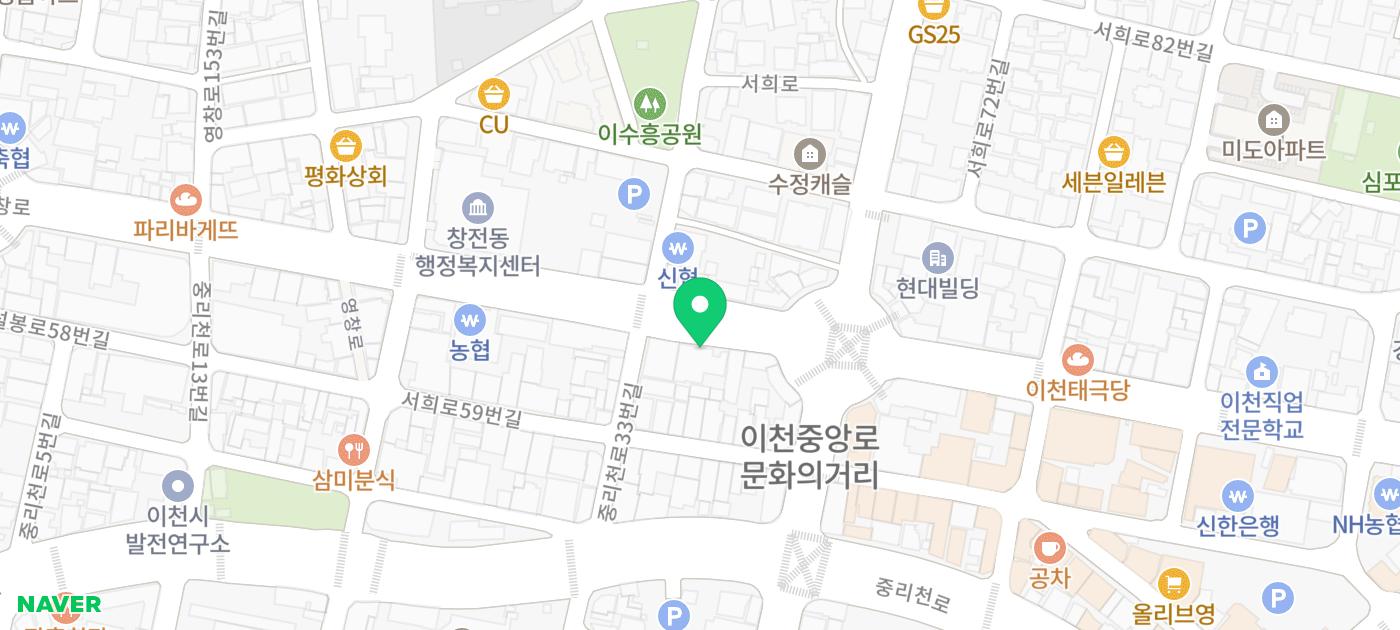
[Directions]
Address: 1F Baeyoung Building, 178 Yeongchang-ro, Icheon-si
Silver Intersection (former KEB/Hana Bank site)
Across from NC Department Store,
the building right next to Davich Optical Icheon Central
About 100m toward
Shinhan Bank / Kookmin Bank
[By Public Transit]
Gwango-dong stop:
Go straight about 200m toward Shinhan/Kookmin Bank
Shinhan Bank stop:
Go straight toward Gwango Market,
then it's across the Jungang Intersection
[Parking]
When using the Gwango Market public parking lot,
1 hour of free parking is available.
Icheon Kyunghee Yakson Korean Medicine Clinic
Kyunghee Yakson Korean Medicine Clinic
178 Yeongchang-ro, Icheon-si, Gyeonggi-do
Check-in for this blog
Other posts about this place