
Questions Patients Ask Before Treatment, Answered by the Director Himself
In the consultation room, there are questions
patients always ask before treatment.
Especially those who are visiting a Korean medicine clinic for the first time,
or who come after being treated elsewhere,
tend to wonder about similar things.
In fact, if you know the answers to these questions in advance,
you can start treatment with much greater peace of mind.
Today,
I've put together the four most frequently asked questions.

Q. Isn't herbal medicine
bad for the liver?
This is the question I receive most often.
It's safe to say about eight out of ten patients ask it.
To get straight to the point,
it is not true that herbal medicine is unconditionally bad for the liver.
Since herbal medicine is still medicine,
there are cases where caution is needed
depending on one's constitution or underlying conditions.
That's why, before prescribing, we carefully check
the patient's current health status,
the medications they're taking, and whether they have any underlying conditions.
If necessary, we also run blood pressure checks
or basic tests alongside.
We never prescribe right away without confirming.
Rather, herbal medicine that is properly prescribed to suit your constitution
can work to support recovery
rather than burden liver function.
The saying "herbal medicine is always bad for the liver"
is closer to a baseless misconception.
If you're worried, just tell us your current condition during the consultation,
and we'll guide you safely accordingly.

Q. Can I take it together with Western medicine?
This is something many people worry about.
Taking herbal medicine and Western medicine together
is not in itself dangerous.
However, depending on the type of medication,
there are cases where interactions need to be checked.
At our clinic,
we first check the list of Western medicines you are currently taking.
Then we review the possibility of interactions on a case-by-case basis,
and if necessary, we advise you
to separate the dosing times
or adjust the amount for a certain period.
If it's a combination that requires caution,
we also explain in advance
what symptoms may appear.
What's dangerous is "taking it without telling us,"
but if you let us know,
we can adjust it safely.
Taking Western medicine
doesn't mean herbal medicine can't be used,
so if you have any medications you're currently taking,
feel free to let us know.
We'll check it and proceed
in a safe way.
Q. My X-ray/MRI came back normal.
Can treatment still help?
I also receive this question very often.
The first thing I'd like to say is that
just because there are no abnormalities on an X-ray/MRI
doesn't mean there is no cause for the pain at all.
MRI and X-ray are tests specialized
for viewing bones, discs, and joint structures.
Conversely, minute inflammation or partial damage
to soft tissues such as muscles or ligaments
may not show up well on these tests.
At our clinic,
we use ultrasound equipment
to check the condition of soft tissues in real time.
We have you raise your arm,
bend your knee,
and actually perform the painful movements yourself,
so we can confirm where it catches,
and then we look at the problem area together on the screen.
If your MRI came back normal but you kept hurting,
there are many cases where the cause becomes visible
when checked with ultrasound.
The words "normal on testing" may not be the answer.
When you change the way you look, there are things that become visible.

Q. I was told it's degenerative, so there's nothing that can be done
When people receive a diagnosis of a degenerative condition,
many think, "It's because of age, so I just have to put up with it."
Those around them say the same thing, too.
But just because there are degenerative changes
doesn't mean you simply have to endure the pain as well.
In degenerative conditions, what actually creates the pain
is, in many cases, the inflammation or functional decline
of the surrounding soft tissues rather than the wear of the joint
itself.
While reversing worn cartilage
is difficult with any treatment,
reducing inflammation in the surrounding tissues and restoring function
is very much an area where improvement can be expected.
We don't stop at short-term pain relief; instead,
we take a step-by-step approach from reducing swelling → restoring function → preventing recurrence.
Rather than giving up at the word "degenerative,"
we recommend that you check just how much you can improve
from your current condition.
The course may vary from person to person,
but even just setting the right direction can make a difference.
Besides these, if you have any questions before treatment,
feel free to ask us by phone or via Naver Talk Talk.
Even the smallest things, if you check them in advance,
will let you start treatment with much greater peace of mind.
We, too, believe it's best to begin treatment
when the patient has no lingering questions.
If you make a reservation, you can be seen right away without waiting.
This was Director Seo Se-wook of Kyunghee Yakson Korean Medicine Clinic in Icheon.
Thank you.
[Go to Naver Talk Talk]
[Treatment Hours]
Mon, Wed, Fri 9:00-20:00 (reception closes at 19:00)
Tue, Thu 9:00-18:00 (reception closes at 17:00)
Lunch break (13:00-14:00)
Saturday 09:00-14:00 (reception closes at 13:00)
We are closed every Sunday.
[Directions]
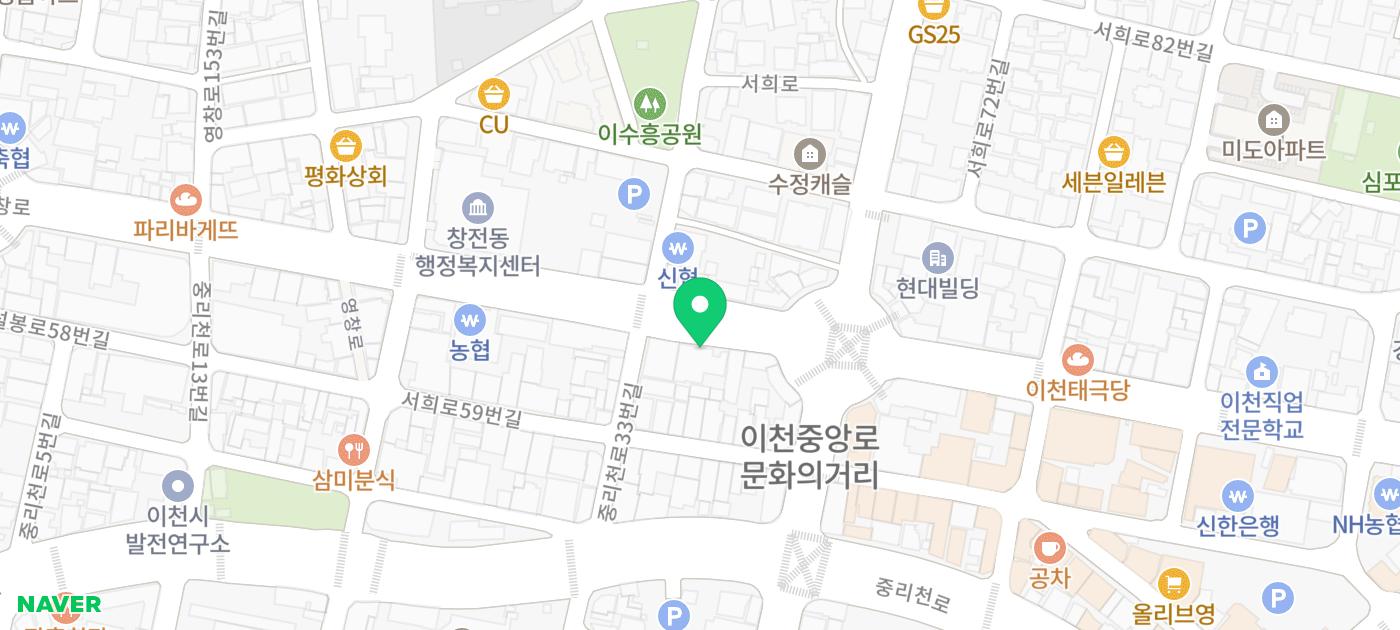
Address: 1st floor, Baeyoung Building, 178 Yeongchang-ro, Icheon
Silver Intersection (former KEB/Hana Bank site)
Across from NC Department Store,
the building right next to Davich Optical Icheon Central Branch
About 100m
toward Shinhan Bank/Kookmin Bank
[By Public Transport]
Gwango-dong stop:
Go straight about 200m toward Shinhan/Kookmin Bank
Shinhan Bank stop:
Go straight toward Gwango Market, then
located across from the Jungang Intersection
[Parking Information]
When using the Gwango Market public parking lot,
1 hour of free parking is available.
Kyunghee Yakson Korean Medicine Clinic, Icheon
Kyunghee Yakson Korean Medicine Clinic
178 Yeongchang-ro, Icheon-si, Gyeonggi-do
Check-in for this blog
Other posts about this place